
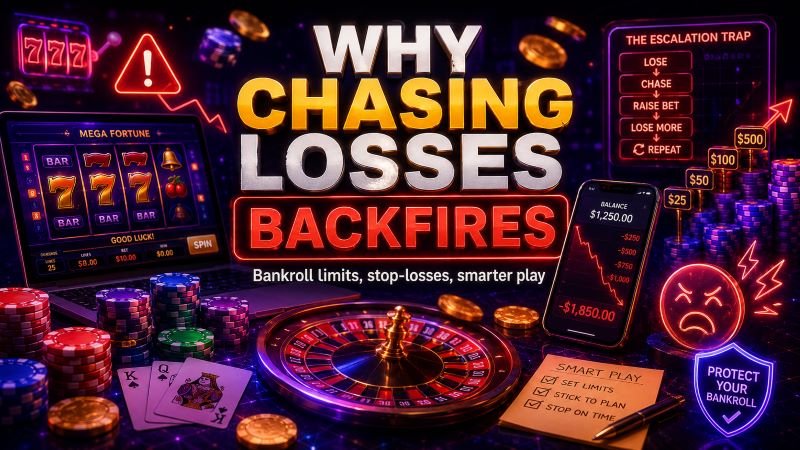
There is a particular moment that every slot player recognizes – although they may never have assigned a name to it. You are down $80, the bonus round has not appeared in the past 40 plays and some small voice in the back of your mind tells you “one more” to get back to break-even. It’s that voice which is the root of all problems. While chasing losses in slots is not a mild form of bad behavior sitting alongside many forms of milder bad behaviors, it is the sole decision which converts a fun Friday evening into a legitimate financial hole.
To truly avoid falling prey to chasing losses; you must understand why you do it. I have spent sufficient amounts of time around casino floors as both a player and writer about gaming behavior, to see this pattern repeat itself with almost monotonous regularity. No one plans ahead to chase losses. It occurs as a result of gradually creeping up on the player – typically a couple of hours into a session when the mathematical aspects of the game cease to align with the player’s mental state.
What chasing losses appears as
Chasing losses is relatively straightforward to describe and far more difficult to identify while it is occurring. It represents raising your wagers, increasing the duration of your session, or using funds that were earmarked for non-gaming purposes, simply to recoup prior losses. Chasing losses does not represent simply continuing to play. Many people continue to gamble for extended periods without deviating from their pre-established limits. The distinguishing characteristic of chasing is the basis upon which the subsequent spin(s) occur. You are not continuing to spin because the activity continues to be enjoyable. This is an important distinction.
An example of a player who continued to wager $2/spin for approximately an hour, lost $150, and ultimately walked away within his established budget, experienced an unfortunate but rational loss at a reasonable price. In contrast, a player who began wagering $1/spin, lost $60, raised his wagers to $5/spin in order to quickly “get back,” and subsequently incurred an additional $300 in losses, departed the table irate and $360 below par — he engaged in chasing losses and he is among the largest mistakes most gamblers with extensive experience claim they have committed at least once.
Psychology underlying it
At this juncture, it begins to become quite fascinating since chasing losses is not merely a function of failing to adhere to discipline as much as a predicable product of how the human brain processes loss. Behavioral economists have extensively documented the concept of loss aversion. This refers to how loss causes approximately twice as much psychological pain as gain provides satisfaction. Since this is an asymmetric relationship, an individual experiences a $200 loss as a significant wound that their brain seeks to immediately rectify — rather than an unpleasant experience caused by a bad hour.

Additionally, the loss aversion is compounded by the Sunk Cost Fallacy. Gamblers often believe that money they have lost remains available to utilize until they remove themselves from play. Consequently, stopping play constitutes throwing away money. However, in reality, money that has been lost cannot be recovered through future play. Lastly, the Gambler’s Fallacy also frequently affects slot players.
The gambler’s fallacy refers to a player believing that after prolonged stretches of losing, he/she is entitled to a win. He/she is not. There is no celestial account book that balances the session. Each and every spin on a contemporary slot machine operates via a Random Number Generator that retains no knowledge regarding previous spins. Therefore, consecutive independent spins provide absolutely no opportunity for patterns. The machine does not know you are down $200; nor does it care. As previously noted, independent spins are precisely independent.
An added component of this dynamic includes the illusion of control — the subtle feeling that altering bet sizes, machine selection, or timing between spins provides an element of control over outcomes that are determined solely by mechanical probability with no discernible exploitable patterns — creates a player who sincerely believes that the increased bet size represents a calculated move based on logical thought rather than an impulsive emotional response. Finally, there exists a less prominent aspect of this phenomenon: ego preservation. Walking away from the table after losing money can produce feelings of inadequacy particularly if you have informed yourself or others that you are “good at this.”
Why chasing losses appears more sensible than it actually is
While desperation-fueled betting contains its own internal logic that appears plausible while you remain immersed within it, it generally takes the following format: I am down $150 and I am confident that my next bonus round will pay between $200-$400 on this machine; therefore, if I make one additional “solid” bet I should be able to achieve parity and leave with nothing lost.
The issue lies in this reasoning treating the next spin as inherently more likely to occur than it is due to your requirement for it to happen. Emotionally driven decision making utilized by slot players during chases virtually always involve similar types of minor distortions in mathematical thinking — not dishonesty with oneself per se, but distorting the actual likelihood of events occurring as needed, i.e., as required by relieving the discomfort associated with losing.
Logic disappears while chasing losses not due to individuals becoming less intelligent; however, because the portion of the brain responsible for assessing cost versus benefit is overcome by the portion of the brain seeking rapid relief from the distressing consequences associated with loss. The above represents essentially the same mechanism which motivates people to continually check wounds in hopes of accelerating healing even though checking has little to no effect on the wound healing itself. At this stage, chasing losses is not fundamentally concerned with the money; it is concerned with alleviating the discomfort related to loss.
Mathematics is indifferent to how you feel
It is also possible to acknowledge intellectually that increasing your bets does not alter the inherent odds of achieving success and yet choose emotionally to ignore that fact. Increasing your bets accelerates how rapidly you deplete your bankroll — nothing more. A slot machine with a 94% Return-to-Player (RTP), returns on average and over an extremely large number of plays 94¢ for every dollar wagered. This leaves 6¢ as house edge.
Regardless of your frustration level, that 6¢ house edge does not diminish; equally irrelevant whether you are patient or impatient — it remains constant and applicable throughout every single spin played throughout your session — there is no house edge disparity with regards to time — if anything longer sessions simply equate to more opportunities for house edge to operate quietly and continuously.
Doubling your bet size after experiencing a loss does not double your chances of recovering those losses in one single spin — it simply doubles your exposure per spin while maintaining all original probabilities and volatility associated with the game. For instance, if a slot machine has a 1-in-300 chance of generating its bonus feature on any individual spin, that number remains unchanged whether you are wagering 50¢/spin or 5$/spin. The larger bet increases only the potential cost associated with each miss — and this is precisely what converts an otherwise acceptable loss ($100 loss over 2-hrs) into an unacceptable ($500 loss in 20-minutes).
Finally, variable ratio reinforcement — representing the primary reward mechanisms employed by slot machines — compounds this problem not maliciously but mechanically according to known principles of psychology. Reward structures employing unpredictability and intermittence create the most resistance toward extinction among all reinforcement patterns identified within psychology — similar mechanisms contribute to the addiction-producing effects associated with checking your phone regularly.
How much chasing actually costs
For illustrative purposes let us assign realistic values to this situation rather than allow them to exist as abstractions — since vagueness rarely changes behavior more effectively than specificity does. Assume that you establish an initial budget of $150 for the night and you elect to wager $1.50/spin. After losing approximately $100 of your initial $150 and finding yourself at a $40 bankroll after roughly 100-spins you find yourself in a position of two choices — or more accurately two paths:
The disciplined choice: recognizing that you have exhausted nearly 75% of your allocated budget for the night you elect to complete your remaining $40 at the same bet size or merely stop play — and retire home after consuming several hours of entertainment for a total expenditure of $150 — an entirely acceptable transactional exchange. Alternatively, the chasing choice: realizing you are near exhaustion of your budget but choosing not to consider it relevant because you are “near”, pulling an additional $100 from your card and doubling your bet size to $4/spin in order to expedite recovery; and now creating decisions with funds originally allocated for non-gambling activities at rates approximately three times as fast as prior bets burn through your bankroll.
That second option illustrates how a planned $150-night can easily transition into an unplanned $400 or $600-night. The former option represents neither an escalator nor slippery slope in terms of morals — rather pure mathematics. The rate at which bankrolls deplete directly corresponds with bet size; and thus, structurally speaking, chasing losses always represents a bet size increase masquerading as a recovery strategy.
Pre-determining limits before you need them
The most effective defense against all of these factors is not self-discipline exercised during moments of play — because in such situations, your emotional system has already intervened and will power has been depleted. Your best defense is predetermined limits established while you are calm — prior to commencing play — that do not necessitate negotiations with yourself during play. Two limits accomplish most of this task for you. Stop-loss limits refer to the maximum amount you are willing to lose before departing from play — regardless of circumstances — established in advance and adhered to as a rigid rule rather than an optional guideline. Think of stop-loss limits as seat belts; not options evaluated during emergency situations.
Take-profit limits work in opposition and matter far more than people realize: Establish in advance how much profit you intend to retain if you emerge victorious — as assuming profits will continue beyond completion is merely an alternate form of the same trap dressed in happier attire. Practically, this entails selecting two numbers prior to loading funds onto a machine: One number representing your intended stop-loss limit (the amount you are willing to lose) and treated as absolute during play — and another number representing how much profit you wish to retain if you emerge victorious (your take-profit limit) — and treated similarly during play.
Crucially, neither number shall be modified once play has commenced — specifically increasing limits during play; particularly after sustaining losses — is essentially the behavior that converts an initially acceptable entertainment budget into an endless fund.
Recognizing when your own warning signs appear
Most players can identify when a session transitions from recreational into something more sinister if they choose honesty with themselves: Betting size increases specifically after experiencing losses (not as part of a deliberate strategy); A developing urgency or irritability that did not exist during an earlier portion of play; Telling yourself “one more” multiple times during a single session; Transitioning from monitoring whether you are enjoying yourself (fun) to tracking whether you are getting closer (or farther) from even — none of these singularities indicate there is necessarily a severe problem; however, collectively repeating across various sessions warrants examination.
Recreational gaming at its best views expenditures (money spent) relative to entertainment consumed (the experience). Entertainment expenditures provide no expectation of refunds (as in viewing a subpar film). Conversely, chasing losses reverses this fundamental aspect — whereas entertainment expenditures represent the price paid for recreation and serve as justification for consumption; chasers view loss (expenditure) itself as justification for continued participation — therefore continually increasing expenditures (bet sizes) without concomitant increases in enjoyment.
The primary reasons for why chasing losses is detrimental — fundamentally disassociate monetary expenditures from consumption (enjoyment) — reversing this rationale serves only one purpose: conversion from discretionary spending into obligatory spending.